
Chess Compositions
Chess composition isn’t just a chess puzzle or a position from a real game. It is a position deliberately created by a composer to make an idea come to life through its unique solution.
Nowadays chess composers respect economy of pieces and moves required by the idea they intend to present.
No.1 – With only four pieces this #2 is still very difficult, thanks to an unexpected first move and a beautiful mating picture in the middle of the board.
No.1
George Edward Carpenter
Dubuque Chess Journal
Oct 1873
Dubuque Chess Journal
Oct 1873
White Kd6 Rc2 Qf3
Black Kd4
#2 (mate in 2 moves) 3+1
→Solution
Solving a composition is more than finding the right move: it’s a chance to discover the ideas and themes that have shaped the art of chess composition throughout its history.
No.2
Richard Réti
Deutschösterreichische Tages-Zeitung,
11 Sep 1921
Deutschösterreichische Tages-Zeitung,
11 Sep 1921
White Kh8 Pc6
Black Ka6 Ph5
= (white to play and draw) 2+2
→Solution
No.2 – Even two kings and two pawns may create a spectacle. This study became famous for the seemingly impossible mission of the white king.
… 12 centuries back in time
Chess compositions are known since their appearance in the oldest surviving chess documents, in the 9th Century. The Arabic chess manuscripts included artistically created chess positions, called mansuba (plural manṣūbāt). They were set to imitate the most dramatic moment of a real chess game, when the side surrounded by the opponent’s threats finds a brilliant winning combinations.
No.3 – diagram
Abū Na‘īm al-Khādim
Book of Chess
842 AD
Book of Chess
842 AD
White Kf8 Rd1 Rf1 Sf3 Pe4
Black Ke6 Rg6 Rh7 Sh6 Pe5
#3 (Mate in 3 moves) 5+5
→Solution
No.3 – While the ancient games lost their importance due to the subsequent changes of chess rules and development of theory, the following mansuba remained extremely popular till today. One of the reasons is the use of Rooks and Knights – the pieces not affected by the change of the rules of chess.
No.3 – painting
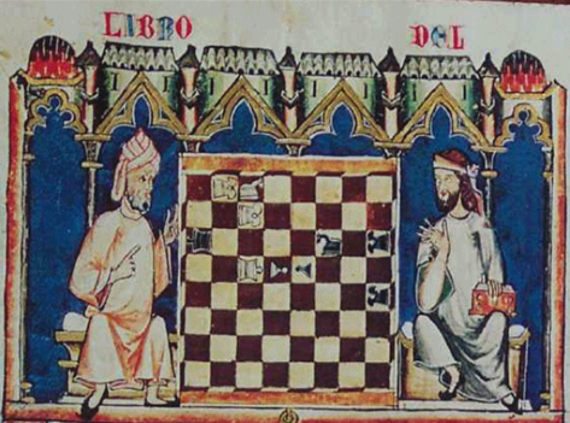
The best chess compositions from Arabic manuscripts became widely famous, the same as their composers. The one above was many times reproduced on different medieval paintings, and in slightly different versions, often with Black to win in the end.
The leading aesthetical principle of mansuba was to imitate the drama of a real game: this is why Rh7 & Sh6 were added. For the side under severe threats, the only solution had to be forced with checks, and the multiple forced sacrifices were the highest model of wonder and beauty. In fact, such criteria are used in many standard chess puzzles on the Internet today, aiming to fascinate the beginners.
When the Arabic chess manuscripts reached the Europe through Spain and Sicily, the new game seemed to be too slow for the noble users in European kingdoms, but the chess composition got a new role. They were reworked and reproduced in different collections, as the object of gambling and betting in a tavern or court. The decorations to imitate the chess game wasn’t needed. This introduced possibility to create solutions with quiet play instead of forced one, and the imagination of potential hustlers have invented many new types of chess problems.
. . .
To be continued…
(Author: Marjan Kovačević)