
The WFCC 70th Jubilee Tourney 2026 (WFCC-70JT)
Preliminary Results
- Section A (Twomovers) – 30.09.2026
- Section B (Threemovers) – 14.09.2026
- Section C (Moremovers) – 28.09.2026
- Section D (Endgame Studies) – 24.09.2026
- Section E (Helpmates) – 20.09.2026
- Section F (Selfmates) – 30.09.2026
- Section G (Fairies) – 03.10.2026
- Section H (Retros) – 30.07.2026
-> Judges appreciation note 👏🏼
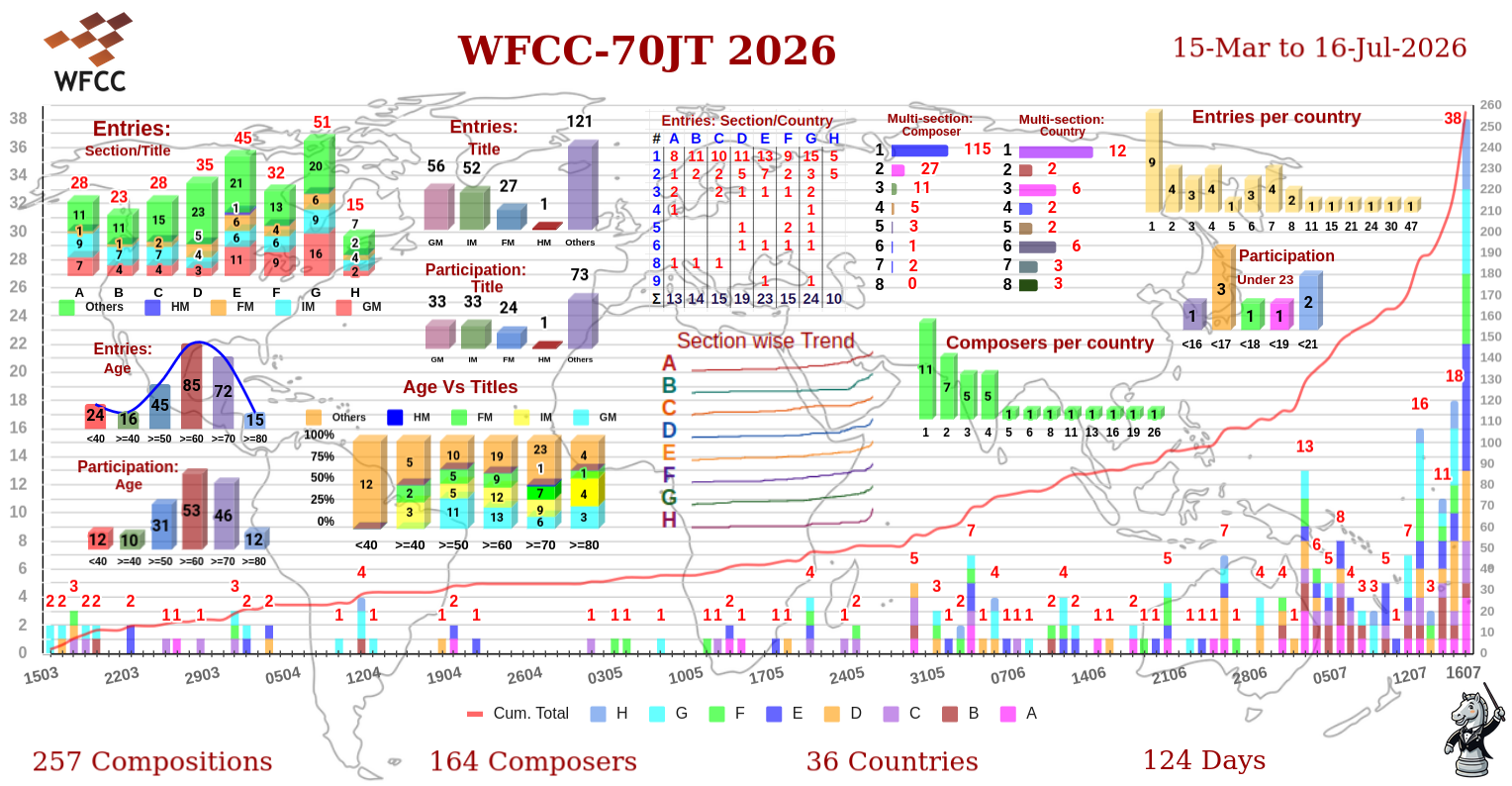
26.07.2026. WFCC-70JT update & STATISTICS:
Heartfelt thanks to all the composers who submitted entries!
And now, the baton passes to the judges. Wishing them a happy, stimulating and rewarding task!
Narayan Shankar Ram, director of WFCC-70JT
Announcement



This tourney is organised to celebrate the 70th anniversary of the founding of the Permanent Commission of the FIDE for Chess Compositions (PCCC), later the WFCC (2010), in 1956. It is based on the format of the FIDE World Cup (8 sections, single judge, one anonymous entry per composer per section).
On the suggestion of WFCC Honorary President Klaus Wenda, the judges have been selected from the countries (or their successors) that were represented at the first ever PCCC meeting at Budapest, Hungary in May 1956.
The tourney director is Narayan Shankar Ram (wfcc70jt@gmail.com).
Composers worldwide are warmly invited to submit their best works.
Sections and Judges
- Twomovers – Kabe Moen (USA)
- Threemovers – Aleksandr Kuzovkov (RUS)
- Moremovers – Oto Mihalčo (SVK)
- Endgame Studies – David Gurgenidze (GEO)
- Helpmates – Marko Klasinc (SLO)
- Selfmates – Hartmut Laue (GER)
- Fairies – Maryan Kerhuel (FRA)
- Retros – Andriy Frolkin (UKR)
Prize fund
In each section:
- 1st Prize – €200
- 2nd Prize – €150
- 3rd Prize – €100
No trophies, medals and physical certificates will be awarded. PDF certificates will be sent to the prize winners.
Tourney Schedule
- Closing date – 16-Jul-2026
- Entries sent to judges (anonymised) – 31-Jul-2026
- Judges submit awards – 30-Sep-2026
- Preliminary awards published (anonymised) – 15-Oct-2026
- Deadline for claims – 15-Nov-2026
- Final awards published – 30-Nov-2026
General rules and conditions
- A maximum of one problem per composer per section is allowed
- Joint compositions are not permitted.
- Submissions should be in PDF format (All sections); PDF and/or PGN (for Endgame studies).
- Entries should be sent as separate files for each section to wfcc70jt@gmail.com.
- Free themes in all sections, but compositions showing themes of the current 12th WCCT are not allowed.
- In the moremovers section (C), selfmates section (F) and fairies section (G), only computer-tested problems (using Popeye, WinChloe or Gustav) are allowed; Participants must specify the program and version used for testing.
- In section E (Helpmates), only helpmates in 3.5 moves and 4 moves are allowed.
- In section G (Fairies), fairy boards are not allowed.
- In section H (Retros), the following restrictions apply:
- 9.1. Entries should focus primarily on the deductive aspect of the past history of the position (“retro genesis”).
- 9.2. Stipulations allowed:
- 9.2.1. Release the position problems
- 9.2.2. Last move(s) problems
- 9.2.3. Defensive retractors with forward defences (only Proca and Hoeg, no Pacific and Klan types).
- 9.2.4. Retro rebuses
- 9.3. Stipulations not allowed:
- 9.3.1. Proof games
- 9.3.2. Illegal and Legal clusters
- 9.3.3. Constructional tasks
- 9.3.4. Enumerations and chess mathematical problems
- 9.4. Fairy boards are not allowed.
- 9.5. Fairy conditions and/or pieces are allowed only in release-the-position and last move(s) problems. They are not allowed in defensive retractors and retro-rebuses.
- 9.6. Fairy conditions allowed:
- 9.6.1. AntiCirce, both Calvet and Cheylan types (After a capture, the capturing piece, including K, is reborn on its home square. If the home square is occupied, the capture is illegal. Captures on the rebirth square are allowed in type Calvet, and not allowed in type Cheylan).
- 9.6.2. Circe (After a capture the captured piece, except K, is reborn on its home square. If the home square is occupied, the capture is normal).
- 9.6.3. Andernach (After a capture, the capturing piece, except K, changes colour. Colour changed Rss on a1/a8/h1/h8 can castle, subject to other requirements of castling).
- 9.6.4. #Colour (After a mating move, the pieces threatening the King change colour. If such changes result in self-check then the pieces do not change colour and the mate is final. In the case of self-check, all the checking pieces retain their colour, not just the piece giving self-check. After such changes of colour, play continues normally).
- 9.6.5. #Remove
(After a mating move, the pieces threatening the King disappear. If such disappearances result in self-check then the pieces do not disappear and the mate is final. If the position after such disappearances is also mate, then the checking pieces are again removed and so on. After such disappearances, play continues normally). - 9.6.6. Rex Multiplex
( Several kings of the same colour may be present on the board, which should have originated through pawn promotion. Three different types of mate are possible, which should be clearly indicated, if mate is part of the solution: Monomate: exactly one King is mated. Supermate and Groupmate are illegal here; Supermate: all Kings are mated simultaneously. Monomate and Groupmate are illegal here; Groupmate, where no King is necessarily mated, but at least one King would be capturable on the next move. Also, Monomate and Supermate are legal here; Example: 1k2K3/kp1R4/8/3Q4/8/8/8/8; #1.
a) Monomate: Qa5#; b) Supermate: Qxb7#; c) Groupmate: Qa5/Qxb7/Rxb7#). - 9.6.7. Chess960 (See https://rcc.fide.com/guidelinesii/)
- 9.6.8. Shatranj
(Queens and Bishops are not allowed. They are replaced by Fers and Alfil. Promotions allowed only to Fers. Pawn double steps, Castling and Illegal positions are not allowed. White Alfils should have originated from c1 or f1. Black Alfils should have originated from c8 or f8.)
- 9.7. Fairy pieces allowed: Nightrider and/or Grasshopper, which should have originated through pawn promotion.
- 9.8. Combinations of fairy conditions and pieces:
- 9.8.1. At most one condition may be used, with or without Grasshopper and/or Nightrider.
- 9.8.2. Shatranj cannot be combined with Grasshopper and/or Nightrider.
Director
Narayan Shankar Ram (wfcc70jt@gmail.com)